
Humility
Another Paradox to Consider

You may be noticing a trend. I am intrigued by the process of growth. As a Meyers- Briggs Intuitive Feeler (NF), growth is something of heroic inner journey full of heart and struggle. It’s a narrative of sorts with a plot and conflict, resolution, climax and denouement.
My thesis is pretty simple. It has been formed from a minute or two struggling with transitions (my current one of leaving the military not withstanding). Success requires an unapologetic confidence in your own capabilities exercised with commitment and determination. It also requires the willingness to strip bare, get the “strike-fighter de-brief” from the “brutally honest nuke”* and toss out a good thing for the sake developing new skills in the face of new challenges.
I am reminded of the scene in Zero Dark Thirty when the CIA Director, played by James Gandolfini, asks Jeremy about Maya after a meeting about her discovery of UBL’s hiding place.
“What do you think of the girl,” he asks.
“She’s fucking smart,” Jeremy replies.
“We’re all smart Jeremy,” he states dryly.
We’re all smart. We wouldn’t be where we are if we weren’t. What makes the difference in the room when we’re all smart?
* The “Strike Fighter De-Brief” from the “brutally honest nuke” is a reference to the de-brief process used in the Strike-Fighter and Nuclear communities within the Navy. Post-event, these two communities follow a cultural practice of checking ego at the door and judging performance based upon standard. These debriefs require personal vulnerability for the sake of professional growth.
Humility is the New Smart
I first came across Hess and Ludwig’s work a couple of years back, right around the time that I found Goldsmith’s work from last week’s post. Hess and Ludwig contend that organizations today are operating with the best talent money can buy. Competition and the requirement to maintain an edge requires more than just competency. The challenges posed by this environment requires more than individual expertise. Multiple perspectives shared via dialogue in a way that brings out the wisdom of the team is the big multiplier.
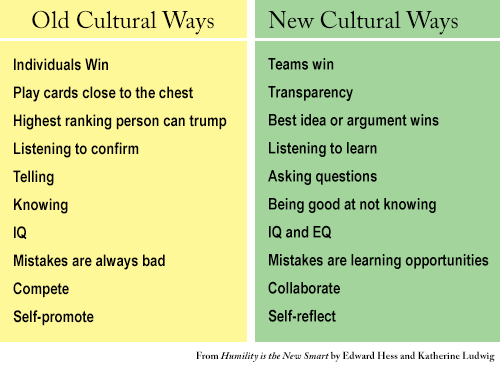
On the left hand side of the chart are a list of self-centered behaviors based upon ego. These behaviors create a me-centric culture that result in an environment where individual success trumps organizational outcome. Despite what the organizational culture may profess, in a results centered world it is easy to fall into the trap of valuing outcome and inadvertently rewarding poor leader behavior. The result ends up being a group of individual high-performers that value their own contributions more than the success of the team. Siloes of excellence form and competition is focused on units within the organization vs. external factors that prevent maintaining and growing edge.
On the right hand side of the chart are a list of team-centered behaviors based upon humility. These behaviors create a team centric culture that result in an environment where the opportunities and challenges are center stage. Individual expertise is pooled in a manner that fosters collaboration and commitment to the problem and its outcome. A community forms where teammates are each others own best advocates, learning occurs naturally, and individual contribution is based upon an ability to modify behaviors to meet the needs of the team. These behaviors lead to a true sense of shared awareness that leads to empowering both teams and individuals to take prudent risk and display initiative.
So What
Two things come to mind as I think about the implications of Hess and Ludwig’s work. They are informed by personal experience.
First, as you move “up the ranks,” your ability to work and contribute as part of team becomes far more important than your individual contribution and/or your expertise. The “down and in” work of managing a team is almost second nature. And it should, chances are you performed fairly well in one or many of those roles.
That perspective is too narrow. It doesn’t account for the teamwork and relationships necessary along the horizontal on the organization chart necessary to stay ahead. Leaders at the next level up need to be cognizant of the work of the broader team in support of the senior executive team. Leaders at the next level are paid to paint a broader understanding that informs executive decision making and develop insights. Your ability to excel on the right side of the chart above really is the difference maker.
Watching senior executive leaders carefully over the last 5 years of my career has been a master’s class in “New Smart” behaviors. Struggling myself to exhibit some of those behaviors reminds me that it’s hard to break out of old-ways. It takes practice and patience. This isn’t about throwing the baby out with the bathwater. You are who you are and trying to be someone else just won’t work. This is about recognizing the value of peer leadership and influence for the sake of leading in uncertainty and complexity v. “Getting Shit Done.”
Second, it’s very easy to under-estimate your own amount of self-awareness. It’s even easier to think you have the capability to modify behavior and learn new skills. By this point in your career, you should fell pretty confident “knowing” yourself. You’ve likely taken your fair share of personality assessments and been de-briefed thoroughly. You may have even taken a few lessons learned aboard and taken steps to create new habits.
As the lead facilitator for the Prospective Commanding Officer leadership course, I had a saying and it applied to many facets of your impression about your capability. However “fill-in the blank” you think you are, divide that by two and take a third of that, and that’s likely how “fill-in the blank” you really are. Think you are approachable, probably not as much as you think. Think you are self-aware, probably not as much as you think you are.
The pros in this space are constantly on the look out for ways to fill in their blind-spots. They seek feedback regularly. They are transparent. They offer their observations about conflict openly and seek deeper understanding. The All-Stars build teams around them to bring experience, perspective, and the ability to collaborate.
=========================================================================
We are just scratching the surface here. I am working to bring high-performing and aspiring executive leaders together into a community of practice. This community is full of folks willing to do the hard work of growing and learning.
Post your comments and share your reflections. Subscribe and share. And as always, if you’d like to talk more about your development journey, DM on LinkedIn or Telegram @WilliamShafley