
Growth
Leader Development Observations Informed by the Greiner Growth Model

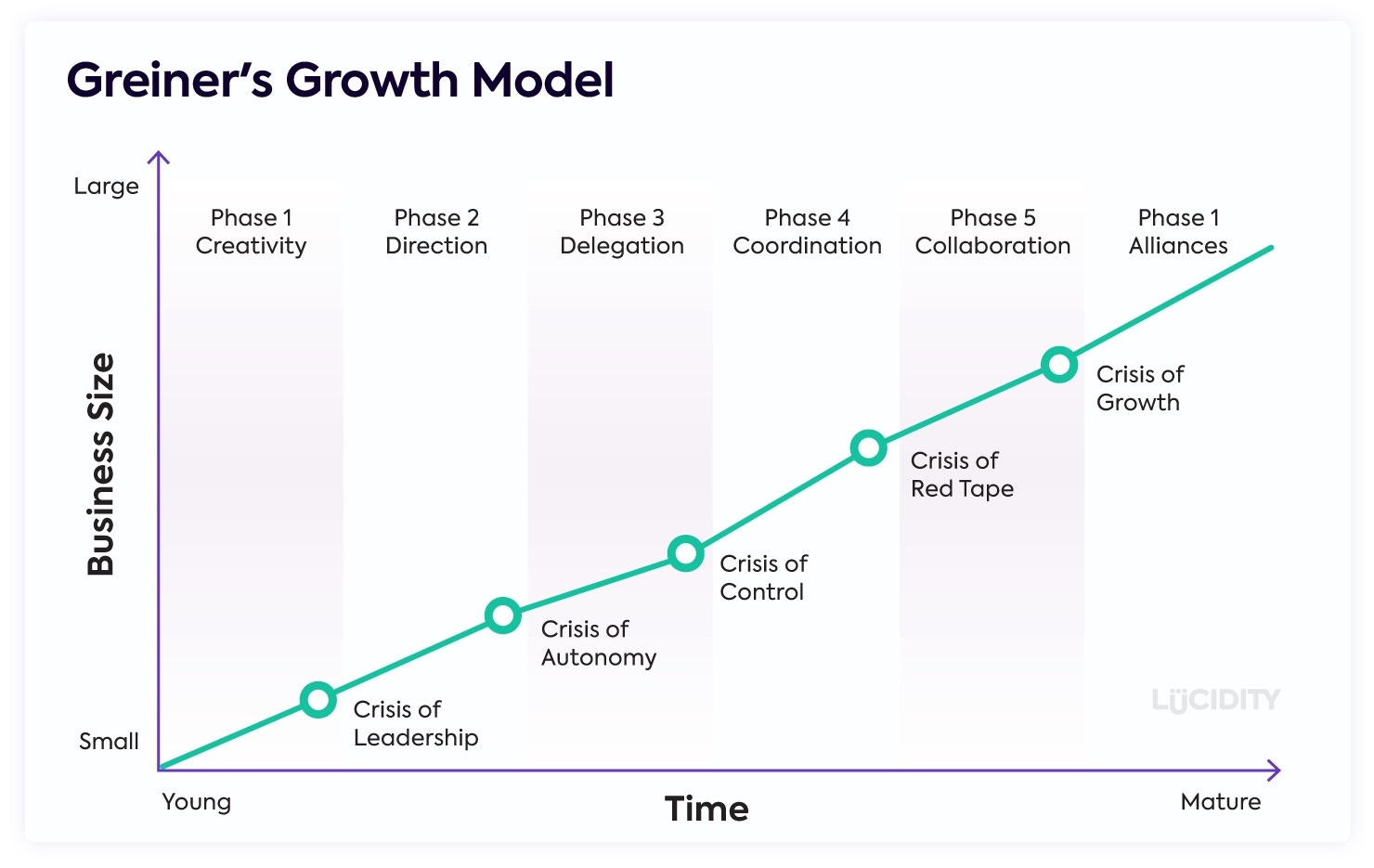
I love models. They provide a way to look at a situation or problem set. No model is perfect. Each have their strengths and weaknesses. Models can be powerful in diagnosing a problem and offering an opportunity to move forward.
I stumbled upon the Greiner Growth model from an old colleague. It is probably run of the mill business school stuff. But, as with many of models I happen upon, I was struck by its applicability to many of the growth challenges I’ve experienced.
Greiner - Simplified
The Greiner Growth model charts business size against time. From small to large and young to mature, organizations take a journey through five phases of growth posed by five leadership crisis challenges.
As an organization grows from idea to its nascent stage, a charismatic leader with a small team can move the team adequately. As the organization grows beyond the ability of that small team to maintain a span of control through mostly directive managerial styles, leaders and the organization must learn new skills to master delegation and specialization to be successful. Individual and unit autonomy is challenged to assure that the needs of scale are met and necessary coordination takes place to meet business process needs.
The coordination necessary to operate at scale is normally formal. These mechanisms normally include Standard Operating Procedures informed by Job Descriptions, formal and defined work flows, both managed via some sort of cadence. As formality increases, there is a tendency to take it too far. The organization ossifies and effectiveness and efficiency suffers as the informal collaboration necessary to remain nimble and agile in the face of complexity is challenged. Any further growth from this state of maturity requires visionary leadership that can create a strategy, garner support from inside and outside the organization, and master a change narrative.
Vertical Development
While the Greiner Growth model is meant for organizations, I would contend it is equally applicable to personal and professional development. It fits nicely within the concept of vertical development. Vertical Development is the process of being able to shift mindsets and learn new skills to perform in ever more complex organizations and situations.
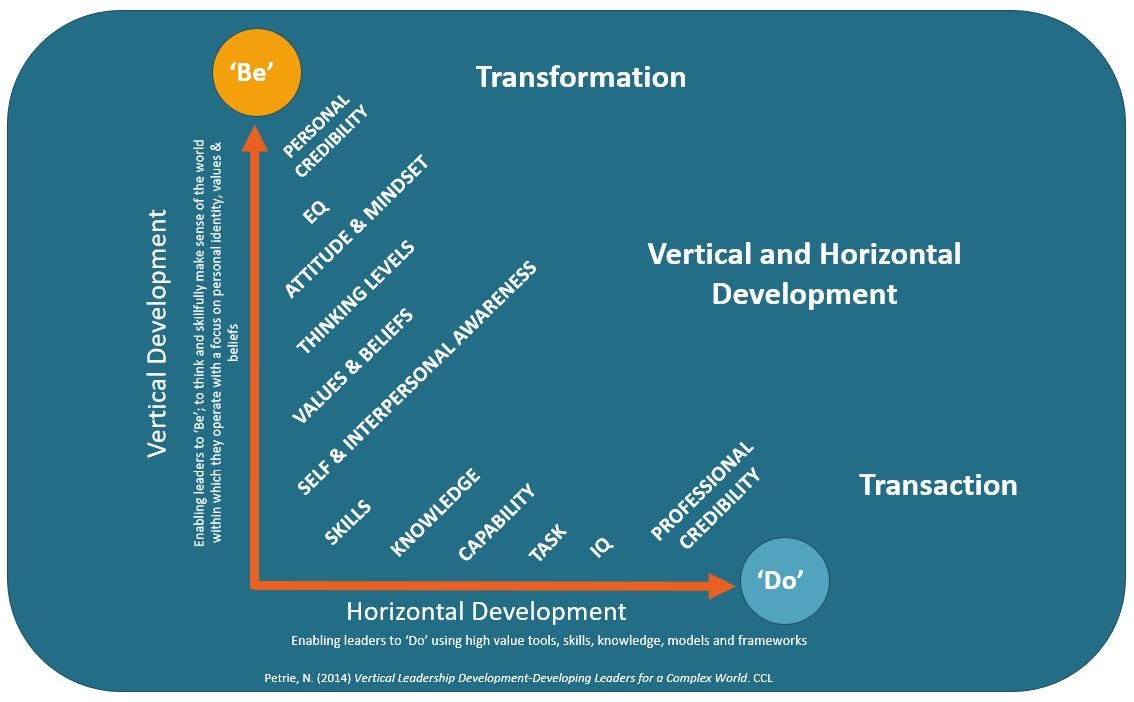
In the chart above, most of us would be familiar with developing leaders along the horizontal axis. As a professional myself, I was guided through a career path with milestones set to assure that I met specific criteria to continue my career at the next higher level of responsibility. Some organizations tackle the hard work of the vertical axis, namely developing the individual’s capacity to create relationships, build consensus, practice self-awareness and use emotional intelligence to tap into the diversity of the larger team. As the graph above shows, a well developed leader both horizontally and vertically has the professional and personal credibility necessary to lead.
The Challenge
I am a strategist and a planner. If I am building an organization or coming into lead an organization, I want to understand the Strengths, Weaknesses, Opportunities and Threats facing the team. I want to know where we sit on the Greiner model, what crisis may or may not lie ahead in our organizational capacity to lead and manage. I want to know the cadre of current and future leaders. I want to balance that knowledge with where we see the organization heading.
Do we have an organizational structure in place to meet our needs and do we have the leadership capacity to exceed our target expectations? Where are our holes? How are we going to fill them? And to meet our growth targets, when do we need to have both leader and structure in place to operate?
This calculus paints a picture of risk. Move to soon and we outpace our capability and capacity, crush our people and loose out as we wrestle with doing what we say we should be able to do. Move too late and we miss a fleeting opportunity to leap ahead of competition.
A Way Through
I see two ways through this challenge. First, walking a core team through a framework like this to unearth opportunity and risk in terms of an organization, its leaders, and its function. Second, assuring that there is a cadre of leaders that exist at various levels in the organization that have both the personal and professional credibility necessary to succeed.
The first, requires a dedicated planning effort designed to understand the organization as it relates to its core function, the external market environment, and an assessment of its ability to operate. This takes a deliberate investment of a leadership team’s time and a process that can return an accurate assessment that leads to viable recommendations. With enough time and effort, most of this could be done internally with some hit to overhead as key members of the team are locked in a room planning instead of generating billable hours.
The second, requires a firm understanding of leader development requirements, an assessment of high potentials and high performers, and some sort of succession plan that puts the right people in the right spots at the right time. Unless your organization has a dedicated Human Resources team that can either do the work of development themselves, you are probably going to need to look externally to get some sort of coaching service for these leaders.
In both instances, being behind the target and having to catch up in either instance puts you a your organization at-risk. Neither of these “fixes” are going to happen quickly (save hiring the next best executive director, general manager, or EVP at a premium…and that may or may not be the golden ticket). I would contend, if you don’t know your vertical and horizontal development needs at least a year from when you need them and have a plan in place to meet them, you are behind. This is especially important in the vertical realm, as developing a leader requires time.
Conclusion
I find models like these fascinating. The framework they provide for understanding complex issues acts as a blueprint for action. When you combine models and frameworks, with experience, individual capacity for critical thinking, and an ability to facilitate a team through a process, you can move from a blueprint for action to a set of SMART (Specific, Measurable, Achievable, Relevant, Time-Bound) goals that can move you from admiring the problem to toward enacting a solution.
Post your observations and comments. Where does this assessment fall short? Where have you seen organizations and leaders struggle with these concepts? If you’d like to talk more about developing leaders and assessing organizational effectiveness, DM me on LinkedIn and let’s continue the dialogue.